Cultivating Extraordinary Achievement: Lessons from Brian Tracy's Leadership Philosophy
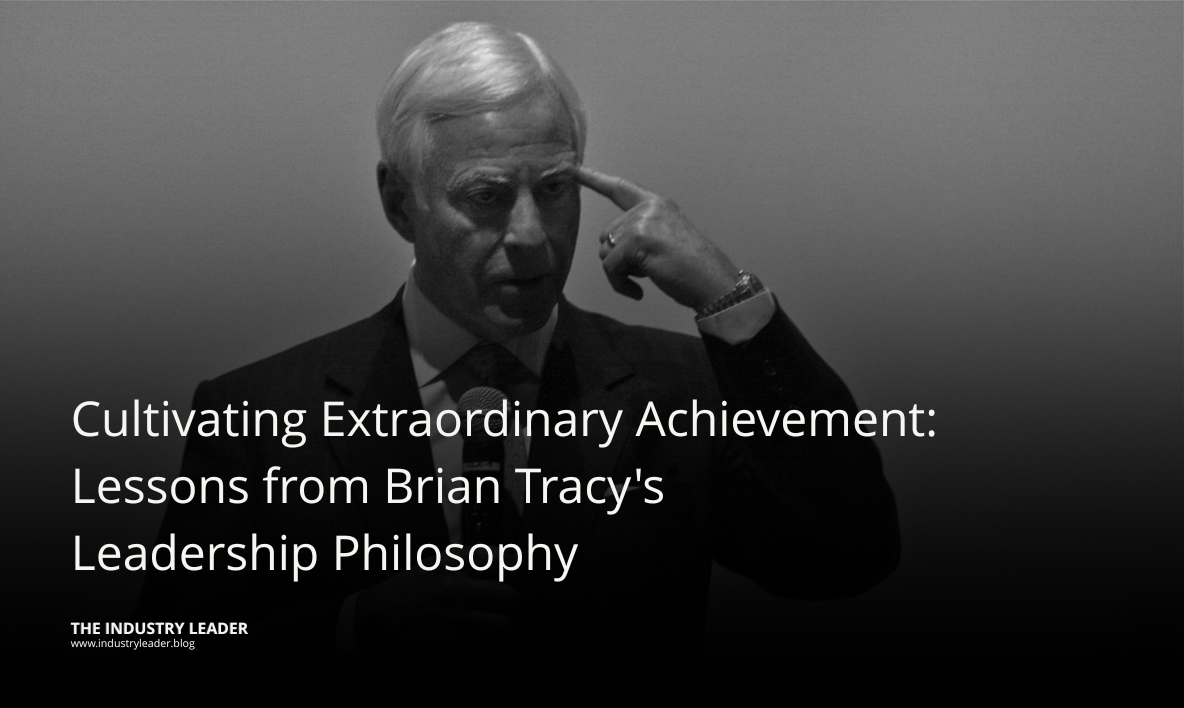
A deep dive into the transformative leadership principles exemplified by Brian Tracy, offering practical insights for creative entrepreneurs aiming to unlock their team's full potential.
every industry needs a leader
•
empower the leader in you
•
every industry needs a leader • empower the leader in you •
Brian Tracy's assertion, "Leadership is the ability to get extraordinary achievement from ordinary people," encapsulates a profound perspective on effective leadership. This statement shifts the focus from an innate trait to a cultivated capacity, emphasizing that true leadership lies in unlocking latent potential within individuals. Tracy's philosophy posits that leadership is a learned skill, not an inherent quality, suggesting that "nobody—not even the greatest you have ever seen—comes into the world a natural leader". Instead, individuals transform into magnetic figures who inspire others to follow. Key components of this transformative ability include inspiring trust, confidence, loyalty, and instilling a sense of meaning and purpose, thereby tapping into intrinsic motivation and enthusiasm for a shared vision.
Tracy distinguishes between transactional leaders, who focus on task completion, and transformational leaders, who are visionaries and path makers. It is the transformational leader who motivates, uplifts, inspires, and empowers individuals to perform at levels far beyond their previous capabilities, aligning directly with the concept of "extraordinary achievement." A critical aspect of this dynamic is the understanding that a leader's internal mindset and self-perception are fundamental to their effectiveness. When a leader genuinely believes in their capacity to inspire and empower, it profoundly shapes their actions and communication, creating an environment conducive to growth. This internal conviction is a prerequisite for external impact, particularly for a creative entrepreneur, where self-leadership forms the bedrock for guiding a team toward bold, innovative thinking.
Furthermore, the attainment of extraordinary achievement, especially in creative and entrepreneurial contexts, often involves innovation and pushing boundaries, which inherently carries risk. While a clear vision and purpose provide direction, psychological safety offers the essential permission and courage for individuals to experiment and potentially fail without fear of negative consequences. Without this supportive environment, even highly motivated individuals may revert to conventional performance. Thus, a leader's ability to articulate a compelling vision and simultaneously cultivate a safe space is intrinsically linked to unlocking truly extraordinary, innovative outcomes from their team.
Brian Tracy: A Living Demonstration of His Principles
Brian Tracy's own life and career serve as compelling evidence of his leadership philosophy's veracity. His journey began without significant financial resources or a college degree in his youth, representing an "ordinary" starting point. Yet, he transformed himself into a world-renowned expert, building Brian Tracy International into a $265 million-dollar company and a globally recognized brand. This trajectory embodies the very essence of his quote, demonstrating his capacity to build an extraordinary organization.
Tracy's influence extends globally; he has consulted for over 1,000 companies and taught seminars in more than 70 countries, speaking to over 5 million people. His prolific authorship of over 70 books, translated into multiple languages, provides practical methodologies for individuals to unlock their leadership potential and achieve extraordinary results. Tracy's entire professional trajectory—from his unprivileged start to becoming a global authority and influencing millions—is a living testament to the "extraordinary achievement from ordinary people" principle. He did not merely advocate this philosophy; he profoundly exemplified it through his transformation, lending significant credibility and inspirational power to his teachings. This widespread impact also highlights that the principles of transformational leadership are not only effective but also highly transferable and scalable. Tracy's success lies not just in leading one entity but in creating a system for developing leaders and unlocking potential across diverse contexts, implying that the mechanisms for eliciting extraordinary achievement are universal and can be systematically taught and replicated.


Empowering Creative Vision: Lessons for Today's Entrepreneur
For the creative entrepreneur, Tracy's principles offer actionable guidance. Fostering a culture of innovation requires cultivating an environment of psychological safety, where it is acceptable to take risks and express ideas without fear of negative repercussions. Failure should be reframed as a learning opportunity, encouraging experimentation and bold ideas. Empowering team members as decision-makers and delegating tasks effectively fosters autonomy, ensuring ideas flow freely and solutions emerge quickly.
Innovation thrives on diverse perspectives and experiences. Creative entrepreneurs should actively seek and foster teams with varied backgrounds, ensuring every voice is heard and encouraging open brainstorming sessions to combat groupthink. Effective leadership also involves communicating vision and setting specific, measurable goals. Tracy's seven steps for goal achievement—identifying, writing down, setting deadlines, listing tasks, creating an action plan, and taking action—provide a practical framework for channeling collective energy toward extraordinary results.
A critical understanding for the creative entrepreneur is the need to be an "ambidextrous leader," balancing operational efficiency with creative innovation. Extraordinary achievements arise not merely from raw creative talent but from the structured application of that creativity. The leader's role is to skillfully bridge abstract ideation with concrete development and implementation. Without operational rigor, creative ideas remain unrealized; without creative freedom, operations stagnate. The ability to fluidly transition between these modes, fostering both discipline and daring, translates creative potential into tangible business outcomes. Conversely, a leader's ego or micromanagement can directly suppress the potential for extraordinary achievement. These behaviors undermine autonomy and psychological safety, creating a climate of fear that limits individuals to "ordinary" performance. To truly lead individuals to extraordinary achievement, one must actively resist the urge to control and instead cultivate humility, trust, and a willingness to empower.
Cultivating a Leadership Legacy Leadership, as defined and exemplified by Brian Tracy, is a continuous journey of self-improvement and the empowerment of others. It involves a constant commitment to learning and adapting. The potential for extraordinary achievement resides within every individual, waiting to be unlocked by visionary, supportive, and empowering leadership. The creative entrepreneur's ultimate legacy will extend beyond innovative products; it will encompass the empowered team built, the culture of excellence fostered, and the ripple effect of extraordinary achievements enabled. By consistently applying Tracy's principles—fostering psychological safety, embracing diversity, empowering teams, and leading with a clear vision—the creative entrepreneur can transform their venture and the people within it. This approach allows for the embedding of principles like empowerment, risk-taking, and learning from failure into the company's very fabric, creating a self-sustaining environment where extraordinary performance becomes the norm, rather than an isolated event.
Information published to or by The Industry Leader will never constitute legal, financial or business advice of any kind, nor should it ever be misconstrued or relied on as such. For individualized support for yourself or your business, we strongly encourage you to seek appropriate counsel.


